
Thank you for Subscribing to Transportation Review Weekly Brief


 Steve Manzi, General Manager
For dealerships, fleets, contractors, and vehicle owners, theft can turn a valuable asset into an immediate loss. Cars can be stolen from dealership lots, trucks can disappear from job sites, and equipment can be taken when businesses are closed. FortiTrak helps customers track stolen assets, identify unauthorized movement, and work with law enforcement to recover them.
FortiTrak approaches that problem with a vehicle tracking and recovery platform built around a straightforward purpose: give customers a reliable view of their assets and help them act when something goes wrong.
The company serves car franchises, used vehicle dealers, small and medium-sized fleets, and businesses that rely on valuable equipment at job sites. Its solutions track vehicles and other valuable assets, provide alerts when they move unexpectedly, and support recovery when theft occurs. From cars and trucks to RVs, trailers, generators, and recreational equipment, FortiTrak gives customers a way to know when an asset is where it should not be. For dealers, however, its role goes further. The same technology can help manage inventory and protect vehicles sold to customers. That broader purpose is what sets the platform apart.
Steve Manzi, general manager says, “We help staff manage inventory while also giving dealers a tracking solution they can offer customers for added protection against theft.”
From Tracking to Recovery
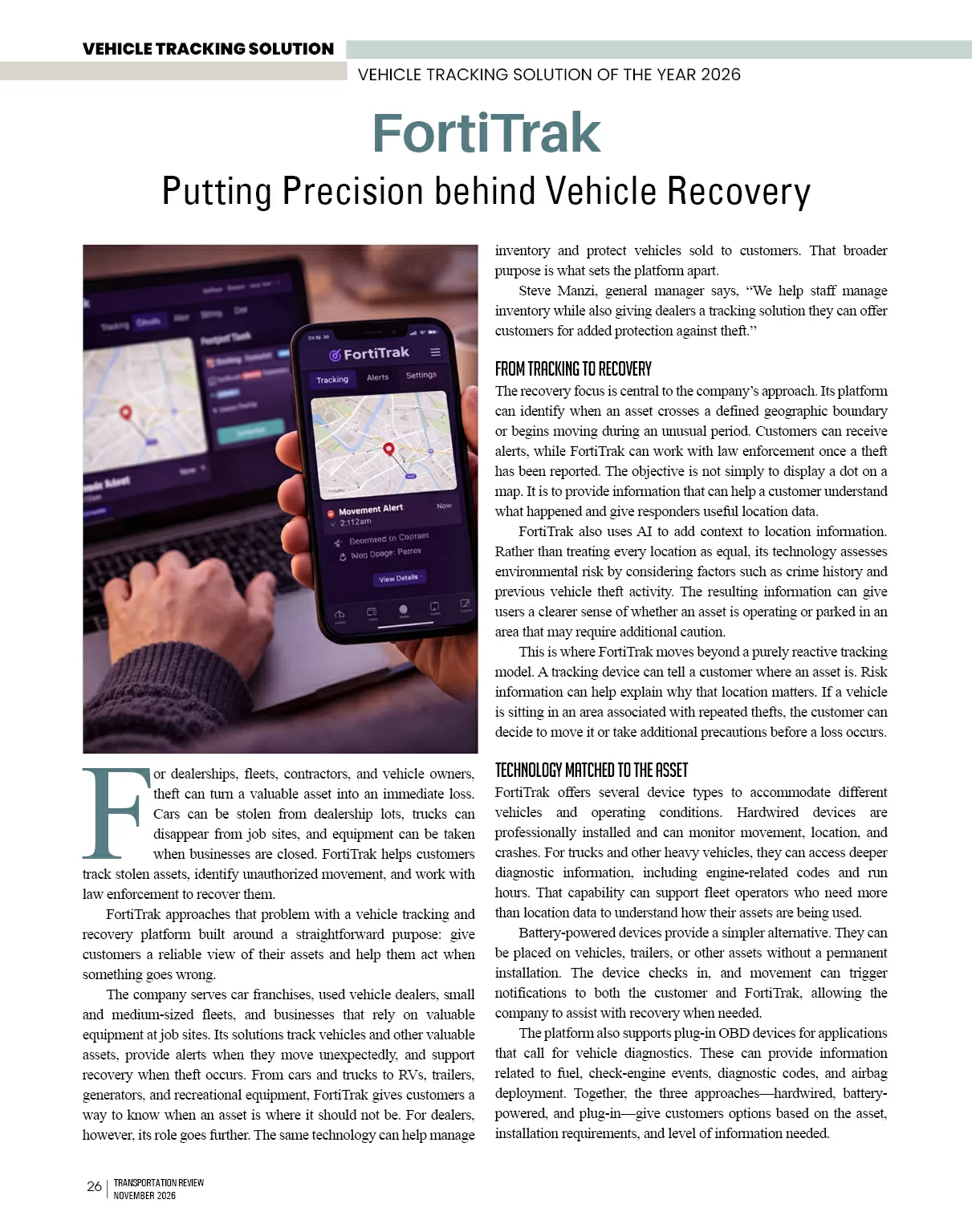
The recovery focus is central to the company’s approach. Its platform can identify when an asset crosses a defined geographic boundary or begins moving during an unusual period. Customers can receive alerts, while FortiTrak can work with law enforcement once a theft has been reported. The objective is not simply to display a dot on a map. It is to provide information that can help a customer understand what happened and give responders useful location data.
FortiTrak also uses AI to add context to location information. Rather than treating every location as equal, its technology assesses environmental risk by considering factors such as crime history and previous vehicle theft activity. The resulting information can give users a clearer sense of whether an asset is operating or parked in an area that may require additional caution.
This is where FortiTrak moves beyond a purely reactive tracking model. A tracking device can tell a customer where an asset is. Risk information can help explain why that location matters. If a vehicle is sitting in an area associated with repeated thefts, the customer can decide to move it or take additional precautions before a loss occurs.
Technology Matched to the Asset
FortiTrak offers several device types to accommodate different vehicles and operating conditions. Hardwired devices are professionally installed and can monitor movement, location, and crashes. For trucks and other heavy vehicles, they can access deeper diagnostic information, including engine-related codes and run hours. That capability can support fleet operators who need more than location data to understand how their assets are being used.
Battery-powered devices provide a simpler alternative. They can be placed on vehicles, trailers, or other assets without a permanent installation. The device checks in, and movement can trigger notifications to both the customer and FortiTrak, allowing the company to assist with recovery when needed.
The platform also supports plug-in OBD devices for applications that call for vehicle diagnostics. These can provide information related to fuel, check-engine events, diagnostic codes, and airbag deployment. Together, the three approaches— hardwired, battery-powered, and plug-in—give customers options based on the asset, installation requirements, and level of information needed.
One Dashboard, Fewer Unknowns
For dealerships managing hundreds of vehicles, visibility can become difficult when assets are constantly moving between sales lots, service facilities, repair shops, and demonstration routes. FortiTrak addresses that challenge with a centralized dashboard designed to put the information in one place.
-
We help staff manage inventory while also giving dealers a tracking solution they can offer customers for added protection against theft.
The company describes this as a one-pane-of-glass approach. Dealers can see what remains on the lot, identify vehicles that have crossed a geofence, and investigate unexpected movements without switching among separate systems. The same principle applies to fleets and job sites, where managers can monitor multiple assets from one portal.
A dealership example illustrates the value. At one Rolls-Royce dealership, a service manager was taking a vehicle home during lunch without the dealership’s knowledge. The tracking platform revealed the vehicle’s movement, allowing management to identify where the car was going and address the situation before an unauthorized trip created a larger liability.
Recovery Backed by Real-World Results
FortiTrak’s value becomes most visible when tracking turns into recovery. In one case, generators stolen from a job site were located at a port before they could be shipped to the Dominican Republic. The customer reported the loss, FortiTrak worked with law enforcement, and the assets were recovered before leaving the country.
A separate dealership theft demonstrated the speed that tracking can provide. A heavy-duty truck was taken after a thief drove through the dealership and broke through vehicles to escape. The vehicle crossed its geofence, triggering an alert. FortiTrak shared information with law enforcement, which was able to stop the truck before the thieves could dismantle it.
In another case, a vehicle purchased through credit fraud was heavily altered, including changes to its VIN and electronics. The installed device helped validate that it was the stolen vehicle, enabling its recovery and saving the customer approximately $45,000.
Built Around Customer Experience
The platform’s features are rooted in extensive automotive experience. FortiTrak’s team brings decades of technical and sales experience, along with more than 30 years of work with customers in the automotive sector. That experience shaped the product from the ground up, incorporating recurring customer pain points into a single platform.
The emphasis is on reducing fragmentation. Rather than forcing dealers and fleet operators to assemble different tools for tracking, diagnostics, alerts, and recovery, FortiTrak brings those functions together. The result is intended to be useful without burdening users with unnecessary information.
That philosophy extends to law enforcement. FortiTrak advises customers to contact emergency services first when an asset is stolen rather than attempting a recovery themselves. Once a case number is available, the company can work directly with law enforcement and provide a link that allows officers to track the device from a phone or computer. Unlike older recovery systems that required specialized equipment, the platform can provide location information within feet through commonly available devices. FortiTrak’s command center can also support officers with questions and help narrow down a vehicle’s location when it may be concealed.
An Added Insurance Benefit
Tracking can also support risk management beyond theft recovery. FortiTrak says consumers who install an active tracking device may qualify for an insurance discount, with the amount depending on the insurer. The company provides a certificate that customers can submit to their insurance provider as evidence that the vehicle has an active tracking system.
FortiTrak is continuing to expand its dealership and fleet customer base and plans to add new locations across the country. Its installation network gives customers the option of professional installation, while those who prefer a simpler approach can install certain devices themselves or choose the battery-powered option.
The company is also preparing additional products and expects to introduce at least three more offerings. Artificial intelligence will remain an important part of that development as FortiTrak looks for practical ways to add capabilities for dealers, fleets, and individual consumers.
“Our goal is to have everything that everybody needed all in one platform, so they didn’t have to look around for different parts elsewhere,” says Manzi.
This approach has earned FortiTrak recognition as the Vehicle Tracking Solution of the Year for 2026, underscoring the company’s focus on combining tracking, risk awareness, diagnostics, and recovery in a single customer-facing solution.
For FortiTrak, the next phase is less about adding complexity than extending what customers can accomplish with the information already available. Whether the asset is a passenger vehicle, a commercial truck, a trailer, a generator, or recreational equipment, the company is building toward a model in which visibility is immediate, alerts are meaningful, and recovery has a practical path forward.
When Vehicle Tracking Must Support Recovery
Vehicle tracking loses value when a fleet manager or dealership discovers movement only after an asset is already missing. The harder buying problem is deciding how much visibility is useful without turning every location change into noise. A dealership may need lot-level inventory awareness and theft response, while a mixed fleet may care more about unauthorized movement and vehicle condition. Assets can also differ sharply in how they are powered, installed, connected or used. A credible system has to accommodate those differences inside one monitoring environment without forcing buyers to piece together separate tools or accept the same tracking setup for every vehicle.
Alert design deserves close scrutiny. Geofences and movement triggers can surface suspicious activity quickly, but poorly tuned notifications train users to ignore them. Buyers should examine how alerts are generated and how clearly exceptions appear on a dashboard. Location history should also give enough context to distinguish routine movement from an event that requires action. Refresh behavior matters when a stolen asset is moving. A map that looks current but updates too slowly can create false confidence during a recovery attempt. The practical standard is not constant notification. It is whether the system makes unusual movement visible early enough for a responsible response while keeping routine activity readable.
“After a reported theft and case number, FortiTrak can provide law enforcement a browser-accessible tracking link while its command center supports the recovery process.”
Device fit matters just as much as software. Some vehicles can support a hardwired tracker that also reads deeper vehicle data. Other assets, including trailers or equipment moved between sites, may be better served by a self-powered unit that does not depend on permanent installation. Buyers should also look at installation requirements, battery behavior, connectivity gaps and whether the platform retains useful history when an asset temporarily leaves coverage. Hardware that is difficult to install or poorly matched to the asset can weaken adoption before the software is ever tested. A single device format rarely suits every asset class, especially when one organization manages vehicles with very different duty cycles.
Recovery workflow separates basic tracking from a more complete security product. Location data is useful only when it can be shared quickly and safely after a theft is reported. Executives should understand what happens after an alert and who can access live tracking. They should also test how easily law enforcement can receive location information. Large inventories become difficult to manage if users need separate logins or disconnected views for different asset groups. Buyers should verify who supports an active incident once the vehicle leaves a familiar area. Software may show where an asset is, but recovery depends on how cleanly that information moves into the hands of people who can act on it.
FortiTrak combines hardwired trackers with battery-powered devices to cover permanently installed vehicles and assets that need a simpler placement model. Its dashboard brings asset locations into one view and can flag movement outside defined geofences. OBD plug-in devices can add vehicle diagnostics where that information is useful. FortiTrak can also assess location-based theft risk and surface a risk indication before an incident occurs. After a reported theft and case number, FortiTrak can provide law enforcement a browser-accessible tracking link while its command center supports the recovery process. The mix of hardware flexibility and direct recovery support makes FortiTrak a practical option for dealerships and fleets that need tracking to extend beyond location display into incident response.
...Read more
Vehicle Tracking Solutions Info
Q1
What Do Vehicle Tracking Solutions Help Businesses Manage?
Vehicle Tracking Solutions combine location data and connected devices to help users monitor vehicles, spot unexpected movement and respond to security concerns. Depending on the system, functions may include geofencing, movement alerts, diagnostics and location history. Together, these tools give organizations a clearer view of assets moving between business premises, service locations and job sites. Timely location information can also help when communicating with law enforcement after a theft.
Q2
How Does FortiTrak Use Tracking Technology to Support Theft Prevention and Recovery?
FortiTrak’s Vehicle Tracking Solutions pair asset monitoring with alerts and recovery support. Its platform can notify users when a vehicle crosses a set geographic boundary or moves at an unusual time. It also applies AI to location data, assessing environmental risk through crime history and previous vehicle theft activity. That context can help users judge whether an asset is in a higher-risk area. After a theft is reported, FortiTrak can work with law enforcement and give officers a browser-accessible tracking link. Its command center also assists in locating the asset.
Q3
Which Tracking Devices Suit Different Vehicle Types?
Vehicle Tracking Solutions rely on different hardware depending on the asset, installation conditions and information required. Professionally installed hardwired devices can monitor movement, location and crashes. On heavy vehicles, they can also provide engine-related codes and run-hour information. Battery-powered trackers offer a portable option for trailers, generators and other assets that do not need permanent installation. Plug-in OBD devices can add information such as fuel levels, check-engine events, diagnostic codes and airbag deployment. The right device depends on the vehicle and the information users need to collect.
Q4
Why Do Geofencing and Centralized Dashboards Matter?
Geofencing creates virtual boundaries around places like dealership lots or work sites. If an asset leaves the set area, the system sends an alert. A centralized dashboard puts notifications and asset locations in one place, so users don’t have to switch between tools. For organizations with many vehicles, Vehicle Tracking Solutions help spot unauthorized trips, check locations, and look into unusual activity. Alerts should highlight important exceptions without flooding users with routine updates.
Q5
How Can Vehicle Tracking Solutions Offer More Than Location Monitoring?
Vehicle Tracking Solutions combine location data with vehicle condition details and risk indicators. Diagnostics help users understand engine events or how a vehicle is used, while risk insights based on location can prompt action before theft happens. Recovery support is also important. Buyers should look at how quickly location info can be shared during an incident, if different asset types can be tracked in one place, and what help is available after a theft. These features set full asset security apart from simple location tracking.
Q6
What Should Organizations Consider When Choosing Vehicle Tracking Solutions?
When assessing Vehicle Tracking Solutions, organizations should consider the assets being monitored, installation requirements, power options, alert settings and the level of vehicle information required. They should also understand how the provider supports theft response and how authorized responders can access location details. FortiTrak brings hardwired, battery-powered and OBD tracking options together in one platform, alongside a dashboard for monitoring multiple assets. Its approach combines location visibility, diagnostics, AI-supported risk context and recovery assistance, bringing security and routine monitoring into the same view.
Company :
FortiTrak
Management Steve Manzi, General Manager
Description
FortiTrak delivers vehicle tracking and recovery solutions for dealerships, fleets, and asset owners. Combining real-time location data, geofencing, diagnostics, AI-driven risk insights, and law-enforcement support, the company helps customers monitor valuable assets, respond to suspicious movement, and recover stolen vehicles.