
Thank you for Subscribing to Transportation Review Weekly Brief


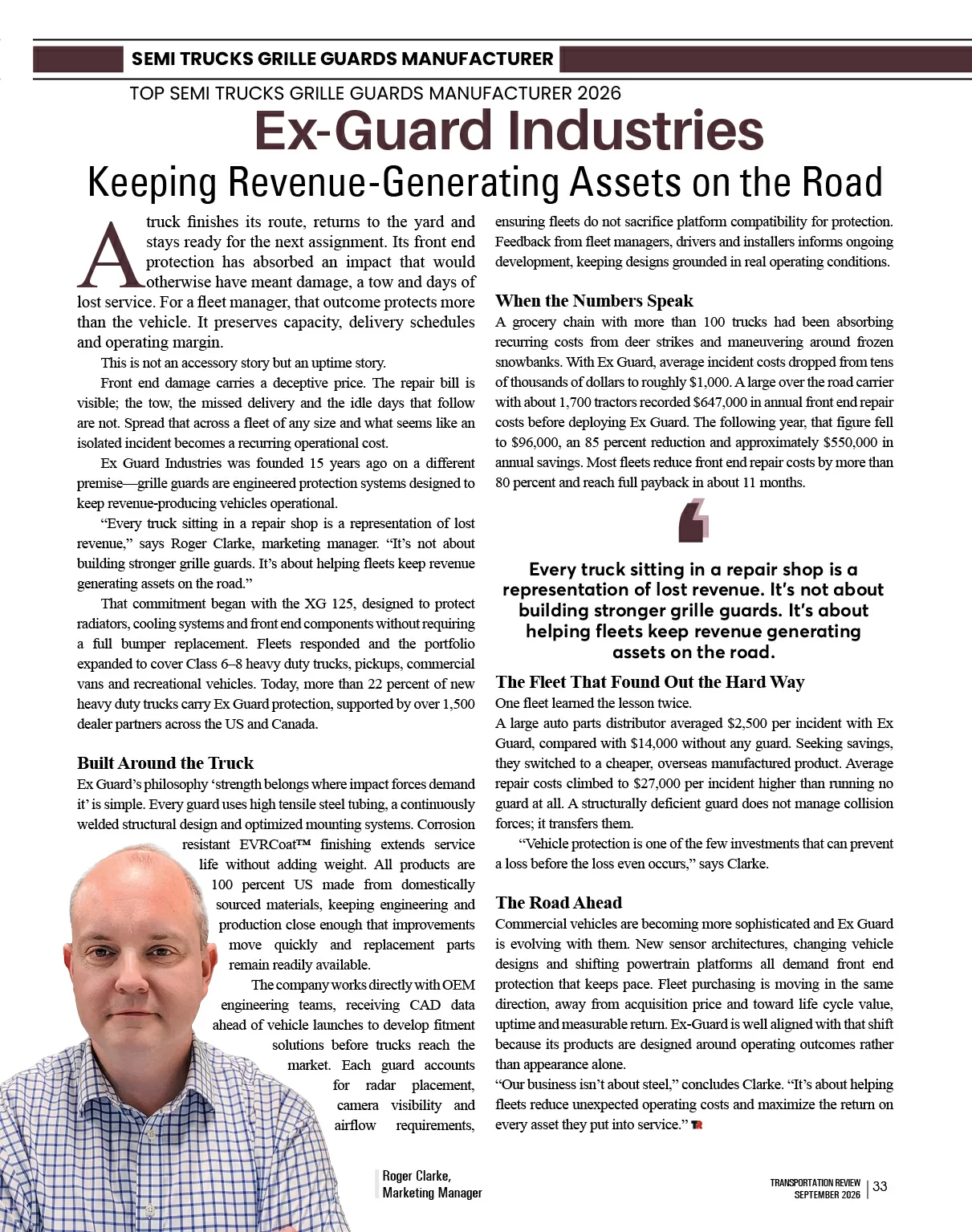
 Roger Clarke, Marketing Manager
A truck finishes its route, returns to the yard and stays ready for the next assignment. Its front end protection has absorbed an impact that would otherwise have meant damage, a tow and days of lost service. For a fleet manager, that outcome protects more than the vehicle. It preserves capacity, delivery schedules and operating margin.
This is not an accessory story but an uptime story.
Front end damage carries a deceptive price. The repair bill is visible; the tow, the missed delivery and the idle days that follow are not. Spread that across a fleet of any size and what seems like an isolated incident becomes a recurring operational cost.
Ex Guard Industries was founded 15 years ago on a different premise—grille guards are engineered protection systems designed to keep revenue-producing vehicles operational.
“Every truck sitting in a repair shop is a representation of lost revenue,” says Roger Clarke, marketing manager. “It’s not about building stronger grille guards. It’s about helping fleets keep revenue generating assets on the road.”
That commitment began with the XG 125, designed to protect radiators, cooling systems and front end components without requiring a full bumper replacement. Fleets responded and the portfolio expanded to cover Class 6–8 heavy duty trucks, pickups, commercial vans and recreational vehicles. Today, more than 22 percent of new heavy duty trucks carry Ex Guard protection, supported by over 1,500 dealer partners across the US and Canada.
Built Around the Truck
Ex Guard’s philosophy ‘strength belongs where impact forces demand it’ is simple. Every guard uses high tensile steel tubing, a continuously welded structural design and optimized mounting systems. Corrosion resistant EVRCoat™ finishing extends service life without adding weight. All products are 100 percent US made from domestically sourced materials, keeping engineering and production close enough that improvements move quickly and replacement parts remain readily available.
-
Every truck sitting in a repair shop is a representation of lost revenue. It’s not about building stronger grille guards. It’s about helping fleets keep revenue generating assets on the road.
The company works directly with OEM engineering teams, receiving CAD data ahead of vehicle launches to develop fitment solutions before trucks reach the market. Each guard accounts for radar placement, camera visibility and airflow requirements, ensuring fleets do not sacrifice platform compatibility for protection. Feedback from fleet managers, drivers and installers informs ongoing development, keeping designs grounded in real operating conditions.
When the Numbers Speak
A grocery chain with more than 100 trucks had been absorbing recurring costs from deer strikes and maneuvering around frozen snowbanks. With Ex Guard, average incident costs dropped from tens of thousands of dollars to roughly $1,000. A large over the road carrier with about 1,700 tractors recorded $647,000 in annual front end repair costs before deploying Ex Guard. The following year, that figure fell to $96,000, an 85 percent reduction and approximately $550,000 in annual savings. Most fleets reduce front end repair costs by more than 80 percent and reach full payback in about 11 months.
The Fleet That Found Out the Hard Way
One fleet learned the lesson twice.
A large auto parts distributor averaged $2,500 per incident with Ex Guard, compared with $14,000 without any guard. Seeking savings, they switched to a cheaper, overseas manufactured product. Average repair costs climbed to $27,000 per incident higher than running no guard at all. A structurally deficient guard does not manage collision forces; it transfers them.
“Vehicle protection is one of the few investments that can prevent a loss before the loss even occurs,” says Clarke.
The Road Ahead
Commercial vehicles are becoming more sophisticated and Ex Guard is evolving with them. New sensor architectures, changing vehicle designs and shifting powertrain platforms all demand front end protection that keeps pace. Fleet purchasing is moving in the same direction, away from acquisition price and toward life cycle value, uptime and measurable return. Ex-Guard is well aligned with that shift because its products are designed around operating outcomes rather than appearance alone.
“Our business isn’t about steel,” concludes Clarke. “It’s about helping fleets reduce unexpected operating costs and maximize the return on every asset they put into service.”
Protecting Uptime beyond the Front Bumper
A grille guard purchase is often approved as a hardware expense even though its financial effect appears elsewhere. Front-end damage can remove a revenue-producing tractor from service, trigger repair scheduling and delay freight already committed to customers. The guard therefore has to be judged by the losses it can prevent, not by acquisition price or visual presence.
Low-speed yard contact and animal strikes create a particular problem for commercial fleets. Damage may extend beyond the bumper into cooling components and lighting assemblies, along with sensor hardware and bodywork. Repair invoices capture only part of the exposure. Towing and constrained shop capacity can keep a truck idle long after the impact itself, particularly when replacement parts are delayed. Procurement teams need protection that limits damage without creating new service burdens.
Fitment is the first serious test. Modern tractors place radar units and cameras across the same front-end area a guard occupies, while cooling systems depend on unobstructed airflow. A design that interferes with a sensor field or complicates routine access can trade one cost for another. Buyers should examine model-specific engineering and collision mitigation compatibility. Installation requirements deserve equal attention, especially when a guard calls for extensive vehicle modification. Protection has little merit if technicians must repeatedly work around it during ordinary maintenance.
Construction should be assessed by how force moves through the guard and into its mounting points. More weight does not automatically produce better protection. Poor geometry or weak attachment can allow the guard to deform into the truck, increasing rather than containing damage. Material choice, welded structure, mounting design and corrosion control should be reviewed as a connected system. Fleet managers also need confidence that the product can remain serviceable after repeated road exposure and seasonal weather.
Support becomes important once deployment moves beyond a small trial. Mixed fleets require accurate fitment and dependable availability across multiple locations. Dealer reach can simplify installation, but factory access matters when a new vehicle platform or sensor layout creates uncertainty. Replacement-part access and warranty response can determine whether a damaged guard is quickly restored. Technical guidance should remain available after the initial order rather than ending at delivery.
"Ex-Guard Industries designs its guards for collision mitigation compatibility, airflow, service access and practical installation, using continuously welded high-tensile steel with corrosion-resistant EVRCoat™ finishes."
The strongest purchasing case comes from lifecycle records. Fleets should track front-end repair spend before and after installation, then compare incident severity with days out of service. Payback calculations should include avoided component replacement and reduced disruption to planned routes. A low-priced guard can look attractive until an impact exposes weaker construction or limited support. The better decision is the one that lowers total loss exposure over the vehicle’s working life.
Ex-Guard Industries merits consideration as a premier choice for fleets applying that standard. Its semi-truck portfolio includes truck-specific XG and EX Series guards, with the XG-125 line built for front-end protection without full bumper replacement. Ex-Guard Industries designs its guards for collision mitigation compatibility, airflow, service access and practical installation, using continuously welded high-tensile steel with corrosion-resistant EVRCoat™ finishes. US manufacturing supports product control and replacement-part access, while a broad authorized dealer network provides local installation support. This combination makes Ex-Guard Industries a practical recommendation for fleets prioritizing uptime and measurable ownership cost.
...Read more
Semi-Truck Grille Guard Manufacturers Info
Q1
What Are Semi-Truck Grille Guard Manufacturers?
Semi-Truck Grille Guard Manufacturers develop front-end protection systems designed to reduce damage to commercial trucks during impacts. These systems can help protect radiators, cooling components, lighting assemblies and other front-end equipment while keeping vehicles operational. Semi-Truck Grille Guard Manufacturers also need to account for modern truck requirements such as radar placement, camera visibility, airflow and maintenance access. For fleet operators, the value extends beyond physical protection because reduced damage can help limit repair costs, towing requirements and vehicle downtime.
Q2
How Does Ex-Guard Industries Approach Truck Protection?
Ex-Guard Industries approaches Semi-Truck Grille Guard Manufacturers from an uptime perspective, treating grille guards as engineered protection systems rather than appearance-focused accessories. Its portfolio began with the XG 125 and expanded to cover Class 6–8 heavy-duty trucks, pickups, commercial vans and recreational vehicles. The company uses high-tensile steel tubing, continuously welded structural construction and optimized mounting systems. Its corrosion-resistant Ever Coat finish is designed to extend service life without adding unnecessary weight.
Q3
What Problems Can Semi-Truck Grille Guards Help Fleets Address?
Semi-Truck Grille Guard Manufacturers help fleets manage the financial and operational consequences of front-end impacts. Animal strikes, low-speed yard incidents and contact with snowbanks can damage more than a bumper, affecting cooling systems, sensors, lighting and bodywork. A suitable guard can reduce the severity of these incidents and help limit repair exposure. Semi-Truck Grille Guard Manufacturers can therefore contribute to lower repair spending, fewer days out of service and better continuity for planned routes.
Q4
What Should Buyers Evaluate When Choosing A Grille Guard?
Buyers evaluating Semi-Truck Grille Guard Manufacturers should consider construction, vehicle-specific fitment, mounting strength, sensor compatibility, airflow and service access. Modern trucks integrate cameras and radar into areas occupied by front-end protection, making compatibility essential. Installation requirements also matter because extensive vehicle modification can create additional service concerns. Material quality, welded construction and corrosion protection should be assessed together rather than viewed as separate features. Replacement-part availability and technical support are also important for fleets operating across multiple locations.
Q5
How Can Grille Guards Affect Fleet Operating Costs?
The financial case for Semi-Truck Grille Guard Manufacturers is closely connected to avoided losses. A damaged truck can generate repair expenses while also creating towing costs, shop delays and missed delivery commitments. One fleet cited by Ex-Guard Industries reduced annual front-end repair costs from $647,000 to $96,000 after deploying its protection, an 85 percent reduction. Across its customer base, the company reports that most fleets reduce front-end repair costs by more than 80 percent and reach payback in about 11 months.
Q6
How Is Ex-Guard Industries Preparing For Changing Truck Designs?
Ex-Guard Industries is developing Semi-Truck Grille Guard Manufacturers capabilities around increasingly sophisticated commercial vehicles. Its engineers work with OEM engineering teams and receive CAD data ahead of vehicle launches to develop fitment solutions before trucks reach the market. Designs account for radar, cameras and airflow requirements while feedback from fleet managers, drivers and installers informs ongoing development. The company also manufactures its products in the U.S. using domestically sourced materials and supports customers through a network of more than 1,500 dealer partners across the U.S. and Canada.
Company :
Ex-Guard Industries
Management Roger Clarke, Marketing Manager
Description
Ex-Guard provides engineered vehicle protection solutions that help commercial fleets stay on the road longer. Through innovative design and customer-focused engineering, the company reduces downtime, lowers operating costs and improves the long-term value of fleet assets.